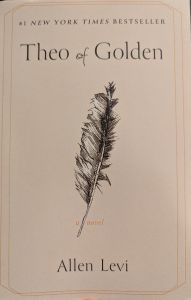
One spring in the city of Golden, a man named Theo moves onto the Promenade. He is eighty-six years old, brought to town on some kind of mysterious business, and he’s not sure how long he’s going to stay. He becomes a regular at the coffee shop The Chalice, because they serve the finest espresso Theo has tasted outside of Europe, and because its walls hang with pencil-drawn portraits of exquisite sensitivity. Theo learns that the portraits are the work of a local artist and feature people who come through the coffee shop and the Promenade outside. Theo is enchanted by the portraits, but believes they belong with their rightful owners: the subjects, or someone who loves them. He conceives a plan to buy up the portraits himself, a few at a time, track down their owners, and arrange a public meeting to gift each subject their own portrait – and if they have time, to hear their story. In doing so, Theo commits himself to “little, nameless, unremembered” acts of kindness, and soon becomes a beloved figure on the Promenade.
That’s it. That’s the book.
There’s a little more to it, of course. More about the mysterious Theo’s background is revealed eventually, though like Theo’s friends in Golden, the reader does not learn this knowledge till the very end of the story. We learn about how he grew up in the vineyards of Portugal, and something of his family – his deceased daughter, his old wife, his lost love. But mostly, the book focuses on the myriad stories of the townspeople of the Promenade in Golden. Tony, the Vietnam veteran turned bookseller, and some of his time in the war. Kendrick, the night janitor of the music university and father to a little girl who was crippled in a car accident. Asher, the artist who created the portraits that Theo has made it his mission to redistribute. There are many townspeople, thus many stories, and the book is predominantly composed of those stories, interspersed with Theo’s almost universally congenial relationships with the Promenade people and the events of the year as it progresses, spring to spring.
Therein lies my problem with the book. It is not a bad book. The prose is lovely, the settings painted beautifully, the stories are many and varied. It is a very nice book. But it did not capture me. It never, at any point in my reading save one, felt real.
For one thing, there is the universal belovedness of Theo himself. He is a character who can do no wrong. He has a particular and refined sense of fashion without being vain. He is always well-spoken, polite, and unfailingly kind. His generosity knows no bounds – not only does he sweep to the aid of his friends in Golden multiple times, he always hides his largest monetary contributions behind anonymity – so he is humble, as well as generous. He only loses his temper and speaks angry words once, for very good reason, and it does not darken his image in the slightest. Theo is presented as something of a saint. Only one recurring character regards him with any suspicion or dislike whatsoever, and she is quickly and easily won over, through no action on Theo’s part at all.
There are sad stories in the book, and a few uncomfortable moments, but only two instances of real tension. One comes toward the middle of the book, and one at the very end. I did feel something because of the latter incident – not on Theo’s account, but because of what was clearly going to happen to two other characters. But even this danger to these other characters was quickly overshadowed by what happened to Theo in the moment, and for that I cared not at all. Theo never felt like a real character to me, so what happens to him didn’t matter to me in the slightest. Nor did the final twist of his real identity at very end.
I contrast this with My Friends, where the artist’s death nearly brought me to tears, even though we’d only known him for a few bare chapters. I was able to connect with My Friends. I could never bridge that gap with Theo of Golden.
Theo is a very pleasant character. Theo of Golden is a pleasant book. If you’re looking for a story about stories, a feel-good exploration of small kindnesses and love between friends, this would probably be a good choice for you. I don’t regret reading it. But I’ll never want to pick it up again.
 C.L. Halvorson
Leave a comment