Book originally read and reviewed end of April, 2026.
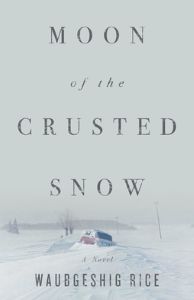
According to the book, “moon of the crusted snow” refers to the month in deep winter where the air is so cold, it freezes the very surface of the snow, creating a crust on top as what remains below stays powdery and light. This season – the depths of deep cold – is the primary setting of the novel, and the primary antagonist to the characters within.
I was recommended this book by a friend in a writing club I’m part of, as an example of a work of anti-colonial fiction. What does that mean? Simply, that we live in a colonial based culture – one that operates under the erroneous but pervasive assumptions of imperial might, white supremacy, and patriarchy. To write in an anti-colonial manner is to challenge these power structures and write fiction that celebrates other ways of life. Whether writing such a book was an intentional or incidental decision on the part of the author, I don’t know. But in telling a story about a First Nations reserve in Northern Ontario, focusing on the Native men and women who make up the community, the author does just that. Moon of the Crusted Snow is deeply rooted in indigenous stories and values. The importance of building community, and taking care of each other within our community, is at the center of the story.
The book opens with Evan Whitesky, a father and public maintenance worker, out on a moose hunt. We see how he’s been preparing for the upcoming winter, filling his freezer with hunted and fished meat, for his own family and for sharing with his relatives and the community elders. We see how he lives with his wife and two small children, how his and his wife’s parents live nearby. Only in recent years has the reserve switched from diesel power to hydro electricity, and they’ve only just received such niceties as satellite TV and cell phone service. These modern luxuries have existed in the community for a short time, but already they’ve come to be depended on, in the same way that many have come to rely on food deliveries of chicken and pork from the South, rather than the moose and fish that is the Anishinaabeg way.
While Evan is out hunting, cell phones stop working. No one thinks much of this – the tower is new, after all, and has gone out before. Then one morning, Evan wakes up to a freezing house. The power is out, and in their reliance on electric heat no one topped off the wood-burning furnace the night before. The chief and elders call a community meeting. They assure the people on the reserve that the diesel generators can still power their homes, and that no one should panic, because more diesel and food is set to be delivered in the next few weeks.
But those deliveries never arrive. Instead, two young men return home from where they’d been attending college in the south, and they bring stories – stories of a widespread blackout, lack of communication, dwindling food supplies, panic, and death. They escaped the city to come home to the reserve, and based on their report, it seems that the power won’t be back on anytime soon, if at all.
Now the community has to consider – how will it survive the fast encroaching winter, with no new food and fuel on the way? How will the elders in charge prevent a panic, how will Evan and his friends help those in the community with less survival experience? And how will the community as a whole deal with the newcomers – white men who followed the tracks of the two boys from the city to the reserve, who have their own ideas on how things ought to be done?
This book makes you sit and grapple with the question: what would you do, if everything shut down today? Would you be able to take care of your family? Would you be there for your community? Would your community be there for you? It’s a chilling thought. As a society, we no longer have the skills, knowledge, and infrastructure to support off the grid living. The panic and hardship that would ensue in the event of such a catastrophe is incredible to consider. What this book advocates, perhaps, is a community-driven response to such an event. There is hope to be found in the story of Evan Whitesky and his family, that even in the face of winter and death, of invading settlers and their grim ideas for survival, of the loss of all modern luxuries, that a community can weather any calamity as long as it acts as a community. As long as its members can step up, reach out in compassion, and take care of one another, then survival is possible. That in remembering and celebrating the old ways, a people may live on, come what may.
There is horror in the premise of this book, and in moments along the way. Community members die, the white visitors are a lurking menace, and the winter itself is portrayed in all its emptiness and chill. But there are also moments of joy, culture and history. We see Evan’s father sharing Nanabush trickster stories with his grandchildren. We see Auntie Aileen, the oldest member of the community, smudge in solemn ceremony. We see Evan and his friends confront the worst of what the white visitors bring. Even in the harshest part of the year, there is light and hope to be found.
Those moments of love and connection are what make the book. It’s a little slow, and in truth, the horrible revelation at the end is somewhat predictable. There’s also a certain amount of ambiguity to the end, especially regarding Evan, where I wanted more solidity. In that sense, it was not as satisfying a read as I would have liked. But still, Moon of the Crusted Snow is a well-told, imaginative story that asks hard questions and provokes real thought. Most importantly, its cultural portrayal of Anishinaabeg ways are truly beautiful to read and a privilege to learn about. For that reason alone, I’d recommend it.


Leave a comment