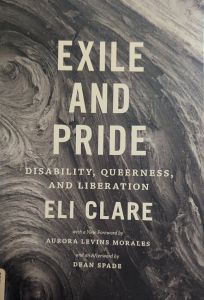
The same friend who recommended El Deafo in response to my concerns about accurately and sensitively writing a Deaf character also told me about Exile and Pride: Disability, Queerness, and Liberation by Eli Clare. In this case, the purpose of the recommendation was two-fold. On one hand, it was in response to my desire to learn more about disability culture, one of the focuses of the book. On the other, it was to address my anxiety about the work I am doing, while writing my novel, to be respectful to the various marginalized groups I am trying to portray. I had recognized, while talking to my friend about my efforts, that it would be impossible to please everyone, that it is inevitable that I will mess up in some way at some point, because I am only human. That as much as I want to mitigate any harm I could potentially do, there is no way to release art that doesn’t upset someone. (One could argue that we should not even strive for such a thing, and I somewhat agree with that sentiment – however, I am strongly committed to minimizing harm as much as possible to marginalized groups who experience enough harm as it is, without my ignorance inadvertently contributing.)
My friend agreed with me that no, it is not possible to move through the world without making mistakes and causing harm. They sympathized with my fear of being cancelled. But they also emphasized that it is clear I am doing my best to educate myself and be respectful, and this ultimately is just as important. They also recommended checking out Exile and Pride, particularly the 2015 edition. This edition has, in addition to the central text, later footnotes by the author offering further thoughts on particular points where his original analysis was flawed or incomplete. My friend used this as an example to show that even the most well-meaning people can make mistakes – but they can also acknowledge those mistakes, and grow from them. That struck me as both important and inspiring, and later that evening I requested the book from the library.
I finished reading it today, and now it’s on my shopping list for my next bookstore excursion. This book, full of disability, queer, and class theory, is absolutely one I want on my shelves, and one I would benefit from revisiting.
That’s probably the driest possible summary I could have given of the book – let me try again. In Exile and Pride, the author discusses, in a series of essays, his personal history as a person with cerebral palsy, a survivor of childhood rape and torture, a rural queer born and raise in a poor logging and fishing town, and a tomboy turned dyke turned genderqueer trans man. He discusses the meaning of home, the struggles of knowing oneself in the aftermath of violence, the conflicts that come from trying to reconcile multiple intersections of identity. He laments the overly commercial, white-focused, upper-middle class privilege often rampant in queer and feminist spaces, and emphasizes the importance of tackling the topic of social change from a multi-dimensional perspective, one that integrates intersections of identity and marginalization.
Clare writes, “Gender reaches into disability; disability wraps around class; class strains against abuse, abuse snarls into sexuality; sexuality folds on top of race … everything finally piling into a single human body. To write about any aspect of identity, any aspect of the body, means writing about this entire maze.” Later on, he reemphasizes, “my body has never been singular. Disability snarls into gender. Class wraps around race. Sexuality strains against abuse. This is how to reach beneath the skin.” That is, only in embracing and exploring the multiple aspects of one’s identity, background, and being can one talk fully and honestly about one’s relationship to oneself and the world one lives in. Similarly, when discussing social progress, it is only by acknowledging the intersections of multiple factors of oppression – race, gender, sexuality, class, citizenship status, and others – that we can make real progress into bringing people together in a society that benefits the many, instead of the few.
One of Clare’s essay deals with the history of clear-cut logging in their home town and rural towns just like it across the country. He discusses the way that environmental groups tend to vilify loggers and other blue collar workers as brutish, backwards enemies of progress despite the very real existential dangers that certain environmental policies represent for loggers. Clare argues that instead of pitting environmentalists against loggers, rural outreach and coalition building between the two groups needs to take place, so that the environment can be safeguarded and rural communities can be aided in finding alternate means of supporting themselves instead of being left to fall into abject poverty. On top of that, both groups need to recognize the real enemy of both environmental protection and worker safety and security – corporate executives, who are behind the push for exploitation of both natural resources and workers in the first place.
Another essay talks at length about the vocabulary used in the disability community – words like handicapped, disabled, differently abled, cripple, gimp, freak. They quote Nancy Mairs in Plaintext and her use of the word cripple: “Differently abled… partakes of the same semantic hopefulness that transformed countries from undeveloped to underdeveloped, then to less developed, and finally developing nations. People have continued to starve in those countries during the shift. Some realities do not obey the dictates of language.” Clare discusses why he is able to comfortably reclaim words like queer and crip for himself, but why he hesitates at freak, despite some in the disabled community using the word proudly. To do this, he examines the history of the freak show, both the exploitation disabled people and people of color suffered and the relative autonomy some were able to achieve through working in them, autonomy that was unheard of for disabled people of the time. He compares the freak shows of the past with the medicalization of disability today, and questions whether today’s paradigm is any less degrading than freak shows were. Of the people who were displayed in freak shows, Clare writes, “They were made freaks, socially constructed for the purposes of entertainment and profit,” much in the same way that disabled people are made disabled, not so much by their own bodies, but by society’s reaction to those bodies, and society’s unwillingness to make accommodations for those existing outside the narrow accepted limits of what is considered “normal.”
The other essays included in Exile and Pride are just as interesting and illuminating as the two I describe above. In the final essay, Clare brings his contemplation to a conclusion by meditating on gender, sexuality, and abuse, on what goes into making identity, and his own journey coming to accept and know himself over the years. He ends in a place of self-assurance and comfort in himself, sitting with people of incredible diversity, “butch women, femme dykes, nellie men, studly fags, radical faeries, drag queens and kings, transsexual people…, intersex people, transgender people, pangendered, bigendered, polygendered, ungendered, androgynous people of many varieties [who] laugh and cry and tell stories… Bold, brash stories about reclaiming our bodies and changing the world.”
Exile and Pride is a beautiful, challenging, visionary book. I am so glad my friend recommended it to me, and I in turn recommend it to anyone who wants to expand their own understanding of the diversity of the world we inhabit together, and how we might make it better for all.


Leave a comment