I’m not always a very good reader of poetry. I read pretty fast, which serves me well with longer works like novels or non-fiction texts, but it’s counter-productive with poems. It can be hard for me to remember to slow down, to be attentive in the way that poetry requires us to be. In addition, some poets embrace an esoteric, abstracted style that tends to elude me. But I do enjoy the challenge of it nonetheless, and it’s a unique sort of pleasure, to find a poem that really speaks to me.
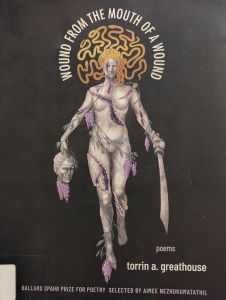
Wound from the Mouth of a Wound was at times challenging for me to grasp. I attribute this largely to my aforementioned struggles with reading poetry; I fared much better on a second, closer read of the poems. What I found was an examination and sharing of deep pain and incredible resilience.
I learned about this book from a dear friend who has recommended a number of books to me in the past and so far, never missed in their suggestions. During our conversation, I had brought up that I was considering putting together a poetry chapbook talking about, especially, my experiences with transition and gender, perhaps also touching on struggles with mental and chronic illness. It’s no wonder that my friend recommended Wound from the Mouth of a Wound to me – the description of my own intended project is an applicable one for this as well.
Greathouse is a trans woman and self-described cripple-punk. I don’t know the nature of her disability, though there are clues in the text, but that doesn’t matter. The frustration and grief that comes with chronic illness is palpable, and you don’t need to know the details to feel it bleeding through the lines. Though our transitions are different – I am non-binary, and Greathouse is a woman – her grappling with the slippery nature of gender, and the struggle against perceptions of gender as held by society at large, by doctors, by the ones we love, in relation to ourselves and how we understand our own identity, felt familiar and illuminating. This is not to say that we’ve had the same experience, not at all. I couldn’t fully relate to everything Greathouse describes in her work. But I don’t need to. The point of reading, after all, is not to see yourself in everything you read. It’s to learn about experiences outside of your own, and thereby expand your own understanding of your fellow humans, the world we share… and yes, of yourself, as well.
Greathouse’s poems share a precision of voice and attention to form that can be visually striking, and serves the content well. She doesn’t work in rhymes, but rather structure – often favoring couplets, but also working substantially in prose-like blocks that sit with weight on the page, heavy and bold. There are several burning haiban, a form that begins with a prose section, proceeds to a blackout poem based on the prose, and finally concludes with a haiku, also drawn from the original block of text. Each of these poems offers three distinct visions, and represents a sharpening of vision, a series of clarifications that are both illuminating and wrenching. Still other poems in the collection play with space and distance, words scattered across the page like clouds or arranged in a broken column, the gaps carrying as much meaning as individual phrases. There is a conversation here between what is said and what is unsaid that manifests both thematically in the content of the poems, and in the forms that they take.
The title of the collection, Wound from the Mouth of a Wound, is a fine representation of the emotional themes at play in the poems collected. That is to say – this is a dark collection. Emotionally, it works in negative spaces. There is anger here, and grief, and fear. But there is also defiance. The author reads as someone who has fought long and hard to understand who she is, and she claims that identity with a tenacity that I find inspiring, precisely because it is not without fear.
Many of the poems deal with disability and the medicalization of the body. The book is divided into five parts (plus a postscript) and most parts include an “Essay Fragment” which explores various models of disability: medical, moral, tragedy, and economic. There is lamentation over the difficulty inherent in navigating our healthcare system, and rebellion against the idea that to be disabled, to be crippled, to be lame, is to be worthless. The word “disabled” (as in “the disabled body”) is always struck out in the text, itself a statement against society’s inclination to view the disabled body as less than, and to push it out of view.
Other poems discuss gender, the author’s experience as a trans woman, and the reactions of those around them to their womanhood. “When My Doctor First Tells Me I Am a Woman” discusses the strange way the medical system “affirms” gender through the clinical evaluation of lab tests, its emphasis on the risks of transitioning, and its unwillingness to treat women’s medical concerns seriously. Poems like “Litany of Ordinary Violences,” “On Using the Wo|men’s Bathroom,” and “When My Brother Makes a Joke About Trans Panic,” discuss the way that violence is an intrinsic part of being a trans woman – that is to say, that violence is imposed upon trans women from the outside, from society, even from their own families. As “Metaphors for My Body, Postmortem” laments, even death isn’t enough to save a trans woman from that violence, in the form of “A body / buried male; Closed casket; / Endless closet.” The denial of identity, even after death, is inherently violent, and trans women are denied their identity at every turn.
It is no wonder the author writes with such fear, and such rage. “Forgive me,” Greathouse writes.
I cannot find the poem in all of this, but I can’t bear to let it go
unspoken. I want to make this violence a stranger in my mouth.
I want to make it something worth remembering.
But it is not all bleak. The final poem, a postscript titled “Ars Poetica or Sonnet to Be Written Across My Chest & Read in a Mirror, Beginning with a Line from Kimiko Hahn,” presents us with a poem that does not seek to separate us from the body, but instead “can’t be read without / it: crippled, trans, woman, & still alive.” What a quiet, meaningful affirmation with which to conclude a powerful collection.
Greathouse has given us a gift with these poems – a frank, unshrinking examination of what it means to be a woman, what it means to be trans, what it means to be crippled, abused, and dismissed. Through it all, through the darkness and the pain, she reveals her own fortitude, defiance, and certainty in herself. This is a poignant and beautiful collection, well worth a read.


Leave a Reply