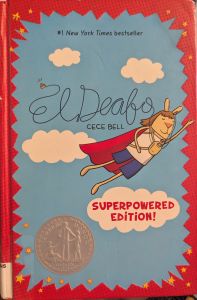
The other day, while having a writing session with a good friend of mine, I talked at length about my efforts in writing my novel, which includes a Deaf protagonist. I mentioned how I messed up a significant part of my first draft relating to her, and how I had to spend time researching the reality and experience of deafness before I felt confident enough to reattempt that chapter – which I felt I had to fix before I could carry on with the book as a whole. At that point, my friend recommended a couple other resources to look into to further my education in the matter. Even though the problem chapter is already rewritten at this point, it is still good to continue learning, so I was eager to request their recommendations from the library. El Deafo was one of these.
El Deafo is inspired by the author Cece Bell’s experience growing up Deaf. In it, the protagonist contracts meningitis as a young child, and experiences profound hearing loss as a result. She’s fitted with a hearing aid of the time, which was worn in a pouch around the neck and connected to the ear molds with wires. Cece goes to kindergarten in a classroom full of kids just like her, with hearing aids of their own. But subsequent years of schooling are in regular classrooms. There, Cece has to wear an even larger hearing aid strapped to her chest, which connects to a microphone that her teachers wear, so that she can hear them clearly. The book chronicles Cece’s experience with the Phonic Ear, and the superhero alter ego, El Deafo, she creates to help her cope with her loneliness and difficulties connecting to her hearing classmates. She learns what she values in a friendship, how to set boundaries with others, and even how to view her hearing loss and the Phonic Ear she uses as a superpower befitting the legendary El Deafo.
This is a charming and engaging book. Cece is a delight to read about, and her resilience and honesty as she recounts what life is like growing up with hearing aids is eye-opening. Her story illustrates how even what is commonly viewed as a debilitating disability can actually be just a normal part of life. Cece is not shy about discussing the troubles her hearing loss has caused her, and her relationship to her own deafness is far from simple. As a hearing person reading this book, it made me appreciate more what the experience of deafness can be like. I say can be, because every Deaf person’s experience will be wholly unique to them, as Cece the author herself acknowledges in her author’s note at the end of the book.
If you’re looking for a way to expand your own understanding about the experiences of Deaf folks, El Deafo is a great place to start. Even if you aren’t, the story of a young girl learning to overcome loneliness and connect with her peers, and the sheer relatability of navigating childhood friendships, crushes, and academic dreams, makes it a worthwhile read.


Leave a comment