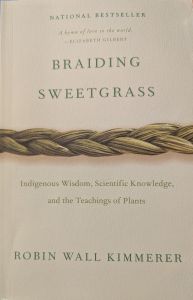
I first read Braiding Sweetgrass as part of the assigned reading in my Creative Writing MFA program at Queens University of Charlotte, though I had heard about the book and been wanting to read it for some time before that. Still, I didn’t expect to encounter it in a Fiction course – the book is nonfiction, part memoir, part cultural essay, part scientific exploration. But that particular course, Stories and Activism, asked its students to consider how we might use stories to make the world a better place. In that sense, this book was a wholly appropriate inclusion.
Braiding Sweetgrass is written by a Potawatomi woman, a botanist and professor, who has done advocacy work for the inclusion of Indigenous cultural wisdom in sustainability efforts, and the introduction of Indigenous students and students of color to the study of environmental sciences. Some of the essays are very personal – for instance, discussing her relationship with an elderly woman in the South, or her efforts to transform an algae-ridden pond into a swimming hole for her children. Others are historical and cultural stories – her grandfather collecting pecans on Indian territory, the generation of Native kids sent to the assimilationist schools to be forced to forget their own language and culture, legends of Sky Woman and sweetgrass and the Windigo. Other essays are lessons based in both scientific and indigenous knowledge, from how to harvest cattails and white spruce roots, or the devastation of the Solvay waste beds and the plants that grow there nonetheless, to the migration habits of spotted salamanders. The book is packed with personal stories, cultural anecdotes, and academic insights, woven into a greater narrative that asks us to consider a new way of interacting with the world – one based on reciprocity, mutual responsibility, and gratitude.
The preface of the book discusses the Indigenous process of braiding sweetgrass – how it is best done by two people, one to hold the bundle’s end and one to braid, how tension and cooperation are necessary to plait the sacred strands. It draws a direct parallel between the act of braiding sweetgrass and the book itself – how Kimmerer as author and us as reader are in a reciprocal relationship with each other and the stories held within. She makes explicit the thesis and purpose of the book: “So I offer…a braid of stories meant to heal our relationship with the world. The braid is woven from three strands: Indigenous ways of knowing, scientific knowledge, and the story of an Anishinabekwe scientist trying to bring them together in service to what matters most…an intertwining of science, spirit, and story…that can be medicine…that allow us to imagine a different sort of relationship [with the earth], in which people and land are good medicine for each other.”
Holding beauty, humility, history, and insight, Braiding Sweetgrass is a gift in written form, and a vital inclusion in the personal library of any person who is concerned about the destructive habits of modern living. It imagines a world where we might approach life not as self-inflated masters of the world but as siblings to it. Nature, be it plants, fungi, animals, or even the very stones, are our family, and can all be our teachers. We can take care of each other, with gratitude and caring. Braiding Sweetgrass asks us to imagine a world in which we approach life in this manner, and to each do our part in bringing it to fruition.
Review originally written on 22 July 2026.


Leave a comment