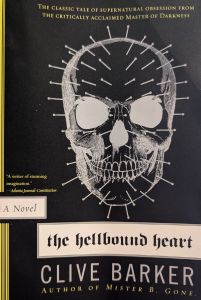
It’s no secret that I love horror. It may well be my favorite genre, to watch or read or play. Horror movies are particularly fun for me, and my favorite of these is Hellraiser. It has been ever since I watched it many years ago at Cthulhu-con in Portland, Oregon. The con took place in an historic movie theatre, and they showed the film up on the silver screen. I loved it immediately. Its combination of cosmic horror and blasphemy speak exactly to my interests in the genre, and its visual effects, score, and storytelling were all brilliant and unsettling.
I’ve known for a long time that the film, written and directed by Clive Barker, was based on Barker’s novella, The Hellbound Heart. Because of that, and because I’ve admired some of Barker’s other writing, I always meant to pick up a copy. It would be worthwhile, I thought, to experience the story in its original form. I was not wrong.
The Hellbound Heart opens with a man named Frank. He is a selfish, amoral man plagued by dissatisfaction. He has tasted of all the world’s pleasures, he thinks, and none of them were enough. There is nothing new for him under the sun, and now he seeks the ultimate pleasure. His search has lead him to Lemarchand’s puzzle box, an inscrutable cube that, when coaxed open, plays a melody that increases in complexity the further you progress in the puzzle. But to open the box is to open a doorway to another world, and to the heirophants of the Order of the Gash. These beings, the Cenobites, are masters of pleasure and sensation – or so Frank has been told – and he summons them, wanting to experience what they have to offer.
What greet him are beings of twisted flesh, mutilated and vulgar and ambiguous, and they promise Frank they can show him sensation the likes of which he has never even conceived. He demands that they show him, and this is his mistake, “the naive belief that his definition of pleasure significantly overlapped with that of the Cenobites.” When dawn rises on the room in which Frank summoned the Cenobites, it is empty. Frank is gone.
Then Frank’s brother Rory, and Rory’s beautiful wife Julia, move into the very house Frank disappeared from. Julia, dissatisfied and despairing herself, makes accidental contact with Frank through the medium of Rory’s blood, and Frank begs her to help him return. To bring him more blood, so that he might escape the hell he willingly admitted himself into. Julia, who has been in love with Frank ever since the two shared a tryst the week before her wedding to Rory, begins to bring Frank victims – men whose blood and vitality he can steal, to rebuild his body and escape the Cenobites’ grip.
Rory is ignorant of this. But not wholly – he can tell something’s up with Julia, and he asks his friend, Kirsty, to talk to her, and find out what’s wrong. Kirsty and Julia don’t get along, but Kirsty is in love with Rory, and will do anything for him. She discovers Frank in his half-formed state, and escapes the encounter with the Lemarchand box, to Frank’s dismay. As Kirsty soon discovers, the box is the key to summoning the Cenobites, and they are not used to losing their prey. Kirsty must draw on all her courage to confront Frank, lest she be claimed by the Cenobites in his stead.
I love this story. I already knew that from the film, and I’ll admit it’s a little hard for me to separate my adoration of Hellraiser from the experience of reading the book it was based on. I can’t help making comparisons. But The Hellbound Heart is worth reading for its own sake. It is sparsely but evocatively written, short enough for a single sitting, and utterly chilling.
The Hellbound Heart is really a story about the depths people will go to, to escape despair. Frank despaired of his own life, thinking there was nothing in it that could bring him satisfaction. This, and his own arrogance, led him to the Cenobites. Julia despairs of having a husband she can really love, a husband who can satisfy her in the way that Frank, in their one wild encounter, did. This pushes her to murder at the behest of a broken, once-human monster. Kirsty despairs of being noticed and loved by anyone, especially Rory, and this is what leads to her encounter with both Frank and the Cenobites she accidentally summons.
The Cenobites, despite their monstrous appearance and horrific appetites, are not the true villains of the story. They obey the rules of their realm – answering the summons of the box, and insisting on the spoils that summoning entitles them to. No, Frank and Julia are the real antagonists, and they are each their own and each other’s downfalls. This book explores what happens when pain and pleasure become intertwined, what lengths we’ll go to for the love we think we deserve. It may make you hesitate to solve the next puzzle you encounter, lest you summon something you are not ready to confront. If you are a fan of horror, and have a strong stomach, I can’t recommend this book enough. Note that both of these are required to enjoy what the story has to offer.


Leave a comment