“There’s a haunted town full of whispered tales about a creaking house of mystery.”
The story begins in a church. We hear footsteps and the creaking of doors as our narrator, Elwood, enters the confessional. “When was your last confession?” asks the priest, Father Iwanicki. Elwood is clearly in distress, and the Father does his best to reassure him. “It’s all right,” he says.
It’s not all right.
With a shaking voice, Elwood says, “I’ve seen evil. Evil beyond human comprehension… Real evil, supernatural evil, malevolent and eternal. Do you understand what I mean?”
Father Iwanicki assures Elwood that he does, and says the power of the Lord Jesus will protect him. But Elwood replies, “No, I don’t think so. Not this time, Father.”
Then the tale begins.
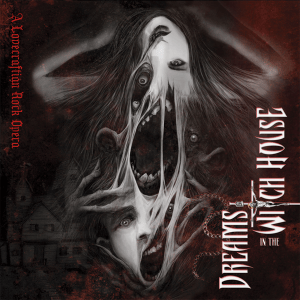
Dreams in the Witch House is described on its website as “A symphonic hard rock fusion of radio theatre and cosmic horror, adapted from H.P. Lovecraft’s, ‘The Dreams in the Witch House’ (1933).” It describes the story of Walter Gilman, a student of mathematics at Miskatonic University in Arkham. He and Elwood are classmates, and live in the same house, rumored to be the home of the accused witch, Keziah Mason, many centuries ago. Keziah disappeared from her cell the night before her execution, leaving behind only scrawled drawings of mysterious lines and curves, and “her disappearance never was explained.” Gilman is fascinated by Keziah’s story, and lives in the same room that was rumored to be hers – a gable room, with strange proportions. He begins to experience bizarre dreams, even as his study of mathematical theory, Keziah’s history, and the strange angles of his room lead him to believe he has discovered a way to travel between dimensions of existence at will. But such knowledge comes with a cost, as Gilman soon discovers.
I’ve yet to read the original story. I do enjoy Lovecraft’s work, generally speaking, and I certainly enjoy the genre of horror he inspired – cosmic horror, the dread of vast, unknowable, unspeakable, and indifferent forces in the universe that play with human lives, when they deign to notice us at all. But “The Dreams in the Witch House” is not one of his stories that I’ve experienced.
Instead, I learned about this album back when I lived near Portland, Oregon, and attended a CthulhuCon held in, if I remember correctly, the historic Hawthorne Theatre. This was over a decade ago, but I remember the carpeted halls lined with goth and punk revelers, the screening of Hellraiser (my first experience of what is now my favorite horror film) and the introduction on stage of a rock opera themed after one of Lovecraft’s short stories. I stayed for the presentation, listened to them perform some of the songs, and knew that I wanted to hear the album in full. I purchased a copy immediately.
The story itself is tantalizing, an exploration of hidden knowledge and grave consequences. Its framing as a confession by Elwood, coupled with Gilman’s struggle with his faith throughout the story and its final, bitter conclusion, makes this a work of religious horror too, in a way. This is another genre of horror I enjoy. I went through a born-again phase in junior high that lasted through my first year in undergrad and was already causing me turmoil long before I graduated from high school. Years of study and reading and sermons and prayer led me to a profound disappointment in God and an abandonment of faith which has, among other things, left me with a hearty taste for blasphemy. So trust me when I say the blasphemy present in Dreams in the Witch House is utterly delicious.
The voice actors and performers on the album are remarkably talented, singing in a range of styles that befit their characters, some operatic, others rough and humble and desperate in turn. The emotion in the performances is dialed up to eleven – one could safely call the album melodramatic, but that’s part of its charm. It doesn’t hold back. The song “Bridge to the Stars” is heartbreaking in its hopefulness, as Gilman shares with Elwood, his doubting professor, and his confounded classmates his discovery of the advanced mathematics that prove inter-dimensional travel possible. “There’s a bridge to the stars / dimensions near and far / we could walk where no man has walked before… expand your mind / the world’s ours to explore.” Gilman longs to uncover the secrets of the universe, to explore the farthest reaches of imagination, to understand – no matter the cost. This fervent curiosity, so innocent at its outset, is what dooms him.
I also have to applaud the decision of the album’s makers to turn Keziah, the ancient witch, into a creature with sex appeal. Her song, “No Turning Back,” is rife with sensuality. I mean, look at these lines: “We’ll consummate a new reality,” “I find your passion sensuous and bawdy,” “your body shivers,” “your sensual discoveries,” “I’m here, your fantasy, “I want you desperately.” Come on now. Yet for all that, Keziah is still described as an “old woman.” I’ve no problem with the makers of the album bringing a little spice into their project – how often, after all, do horror and eroticism stand side by side? Their commitment to not watering down Keziah’s character in spite of this is admirable.
As strong as the story is, it would fall flat in this endeavor without proper musical backing. The album excels in this regard. Symphonic instrumentals back up hard rock guitar that alternately soars and churns, conveying excitement, despair, and terror in turn. Discordant piano, Latin prayers, and cultic chanting add to the atmosphere of mystery and dread. The lyrics tell the story admirably, and there are some banger lines (and a few silly ones). This is the kind of album I can listen to on repeat for days at a time, due to the strength of both music and story.
A brief content warning – Lovecraft, as any modern reader is sure to know, was a notoriously racist and bigoted man. This bled into his fiction – sometimes subtly, sometimes anything but. This album, inspired as it is by one of Lovecraft’s stories, is no exception. Though the races of the characters are not made explicit, Nyarlothotep is referred to as “The Black Man,” a reference to one of his common names in the mythos (the Black Pharaoh). The listener should understand that Nyarlothotep is not referred to as the Black Man because he is a literal Black man, but rather because he is a powerful being of incredible malevolence. This does not refute the racist nature of the title, though (and this trope in fiction of conflating “blackness” with evil is itself problematic for what should be obvious reasons). If this is the kind of thing that can kill your enjoyment of a story, you’re better off avoiding this album. Otherwise, you can approach Dreams in the Witch House as one must approach all of Lovecraft’s works – prepared for some nonsense.
Dreams in the Witch House combines a harrowing story with dramatic lyrics, stellar performances, and blazing music, all of which culminate in a truly excellent listening experience. It’s been one of my favorite albums ever since I listened to it for the first time, all those years ago, and it remains so to this day. It is absolutely worth a listen.
For more information on the project, check out their website, or purchase the album for yourself.


Leave a Reply